

Behavioral interview questions are now used by employers across almost every industry. Instead of asking what you would do, interviewers ask what you have already done. Because of this, many candidates feel unsure about how much detail to share and how to organize their answers.
Fortunately, there is a simple and effective solution. The STAR method helps you answer behavioral interview questions in a clear and confident way. More importantly, it helps interviewers understand your skills quickly.
In this guide, you will learn what behavioral interview questions are, why employers use them, and how the STAR method can help you stand out.
What Are Behavioral Interview Questions?
Behavioral interview questions focus on real situations from your past. Employers believe that past behavior is the best indicator of future performance. Therefore, these questions aim to uncover how you think, act, and solve problems.
Most behavioral questions begin with phrases such as:
- “Tell me about a time when…”
- “Describe a situation where…”
- “Give an example of how you handled…”
Because these questions require storytelling, short answers are rarely effective.
For a general explanation of this interview style, you can review this resource:
https://en.wikipedia.org/wiki/Behavioral_interview
Why Employers Prefer Behavioral Interviews
Employers prefer behavioral interviews because they reduce guesswork. While resumes list skills, they do not show how a person behaves under pressure. As a result, hiring managers rely on real examples.
Behavioral interviews help employers:
- Compare candidates fairly
- Identify problem-solving ability
- Measure communication skills
- Understand accountability
Moreover, this approach helps companies avoid costly hiring mistakes.
Indeed explains this hiring approach clearly here:
https://www.indeed.com/career-advice/interviewing/behavioral-interview-questions
Behavioral vs Traditional Interview Questions
Traditional interview questions often focus on opinions or goals. For example, interviewers may ask about strengths or long-term plans. While these questions still matter, they are easy to prepare in advance.
Behavioral interview questions, however, require evidence. Instead of opinions, they demand proof. Because of this, candidates who use structure perform better.

Why Many Candidates Struggle With Behavioral Questions
Many candidates struggle because they answer without structure. As a result, their responses feel scattered or incomplete.
Common mistakes include:
- Talking too long without focus
- Forgetting to explain results
- Using “we” instead of “I”
- Skipping key details
Therefore, using a clear framework becomes essential.
What Is the STAR Method?
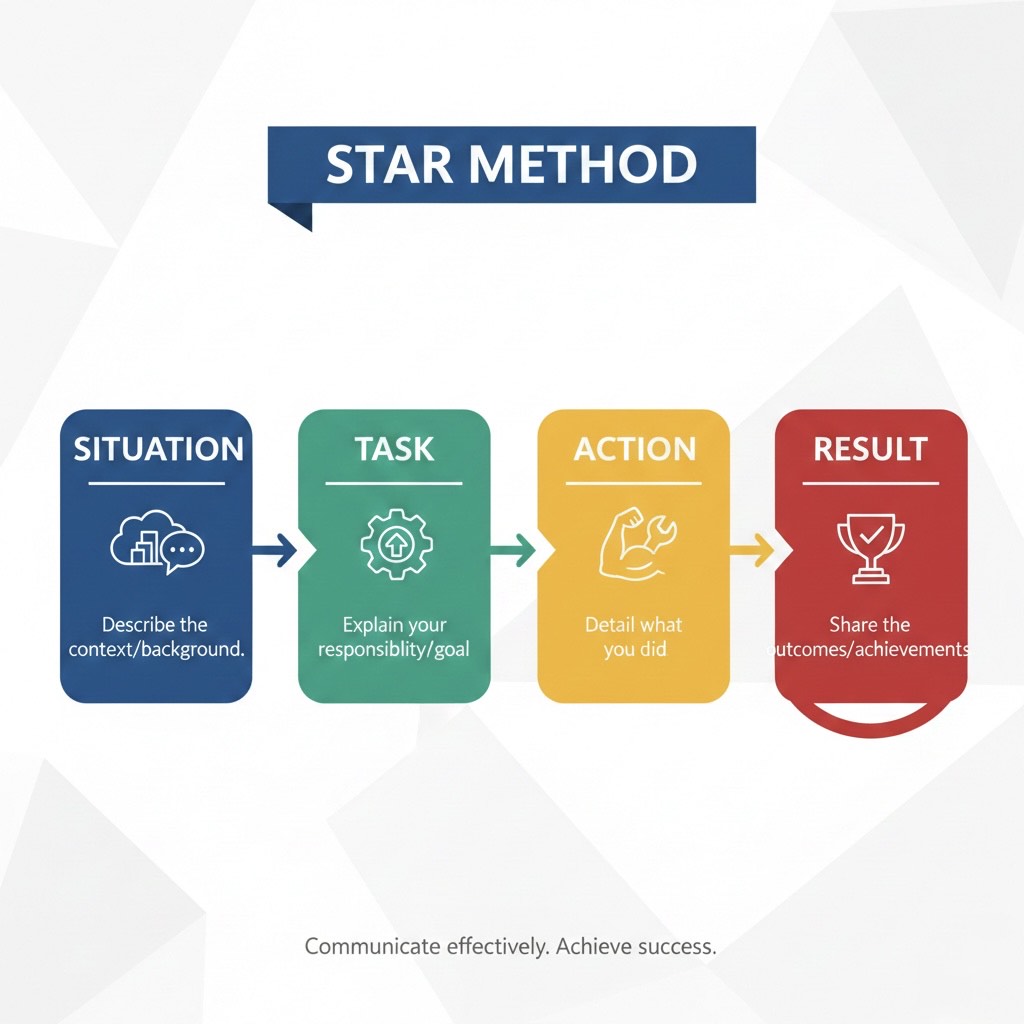
The STAR method is a structured way to answer behavioral interview questions. It helps you stay focused and makes your answers easy to follow.
STAR stands for:
- Situation – What was happening
- Task – What you were responsible for
- Action – What steps you took
- Result – What happened in the end
Because of its clarity, many recruiters expect answers in this format.
You can find an official explanation here:
https://www.indeed.com/career-advice/interviewing/how-to-use-the-star-interview-response-technique
How the STAR Method Improves Your Answers
Situation: Explain the Context Clearly
First, describe the situation briefly. Give enough background to set the scene. However, avoid unnecessary details.
Example:
In my previous role, our team faced a sudden increase in customer complaints.
This helps the interviewer understand the challenge quickly.
Task: Define Your Responsibility
Next, explain your role in the situation. This part shows ownership and accountability.
Example:
I was responsible for handling customer communication and identifying common issues.
Avoid focusing too much on the team. Interviewers want to know what you did.
Action: Describe What You Did
Then, explain the actions you took. This is the most important section.
Example:
I listened carefully to customers, documented recurring problems, and shared feedback with the technical team.
Use clear verbs. Keep sentences short and direct.
Result: Share the Outcome
Finally, explain the result. Whenever possible, include numbers or improvements.
Example:
As a result, response time improved and customer satisfaction increased.
Even if the outcome was not perfect, explain what you learned.

Using the STAR Method Without Work Experience
If you have limited work experience, you can still use STAR. Instead of job examples, you can use:
- School projects
- Group assignments
- Volunteer work
- Internships
What matters most is how you handled the situation.
Common STAR Method Mistakes to Avoid
However, even with STAR, mistakes can happen. Avoid these issues:
- Memorizing answers word for word
- Giving negative explanations
- Skipping the result
- Adding unnecessary details
Instead, focus on clarity and honesty.
How to Prepare Strong STAR Answers
Preparation improves confidence. Therefore, take time to prepare before the interview.
Follow these steps:
- Review the job description
- Identify key skills
- Prepare 5–7 STAR stories
- Practice speaking naturally
- Adjust examples for each role
As a result, your answers will feel smooth and professional.
Why the STAR Method Works So Well
The STAR method works because it matches how interviewers listen. It provides structure, reduces confusion, and highlights impact. Therefore, candidates who use STAR often leave a stronger impression.
Conclusion
Behavioral interview questions are designed to reveal real skills. Although they can feel challenging, the STAR method makes them manageable. By using clear structure, simple language, and real examples, you can answer with confidence and clarity.
Frequently Asked Questions (FAQs)
1. What are behavioral interview questions?
Behavioral interview questions ask candidates to describe real past experiences to help employers predict future performance. They focus on actions, decisions, and outcomes rather than hypothetical situations.
2. Why do employers prefer behavioral interview questions?
Employers prefer behavioral questions because past behavior is a strong indicator of future performance. These questions help evaluate problem-solving skills, communication, accountability, and adaptability using real examples.
3. What is the STAR method in interviews?
The STAR method is a structured way to answer behavioral interview questions using four parts: Situation, Task, Action, and Result. It helps candidates give clear and complete answers.
4. Is the STAR method required in all interviews?
The STAR method is not mandatory, but it is highly recommended for behavioral interview questions because it aligns with how interviewers evaluate responses.
5. How long should a STAR method answer be?
A strong STAR answer usually lasts between one and two minutes. This length allows enough detail without overwhelming the interviewer.
6. Can fresh graduates use the STAR method?
Yes. Fresh graduates can use examples from academic projects, internships, volunteering, group assignments, or personal initiatives to demonstrate transferable skills.
7. What if I do not have work experience?
If you do not have work experience, you can use school projects, volunteer activities, or personal challenges. Employers value how you approach situations, not just where they occurred.
8. Can I reuse the same STAR example for different questions?
Yes, the same example can be reused if it is relevant. However, it should be adjusted slightly to match the specific question being asked.
9. Do STAR method answers need numbers or metrics?
Numbers are helpful but not required. If possible, include measurable outcomes, but qualitative results such as improved communication or learning are also acceptable.
10. What if the result of my story was not positive?
If the result was not ideal, focus on what you learned and how you improved. Interviewers value honesty, self-awareness, and growth.
11. Should I memorize STAR answers before an interview?
No. Memorizing answers can sound robotic. It is better to understand the STAR structure and speak naturally using key points.
12. Can the STAR method be used in virtual interviews?
Yes. The STAR method works equally well in virtual interviews because it provides clarity and structure, which is especially important in online settings.
13. How many STAR stories should I prepare?
Preparing five to seven strong STAR stories is usually sufficient. These can be adapted to answer a wide range of behavioral questions.
14. What types of skills work best with the STAR method?
The STAR method is effective for demonstrating skills such as communication, teamwork, leadership, problem-solving, time management, and adaptability.
15. How can I practice STAR method answers effectively?
You can practice by answering questions out loud, recording yourself, doing mock interviews, or writing brief bullet points for each STAR example to improve clarity and confidence.